Maniformer | November 2026
Maniformer’s new study, drawing on 200,000+ hours of real-robot data, finds that the quality of post-training data is largely decided the moment the collection system is designed.
Paper: https://arxiv.org/abs/2611.22388
A successful demonstration can still teach the wrong lesson
Two demonstrations place an object in a box. One is clean and direct; the other is full of waiting, detours, and corrections caused by sluggish or awkward controls. Both succeed, but the second may teach the model exactly the wrong thing. Pre-training on egocentric data is forgiving of such errors. Post-training on real-robot data is not, because it aligns the model to a specific robot and shapes its action policy directly.
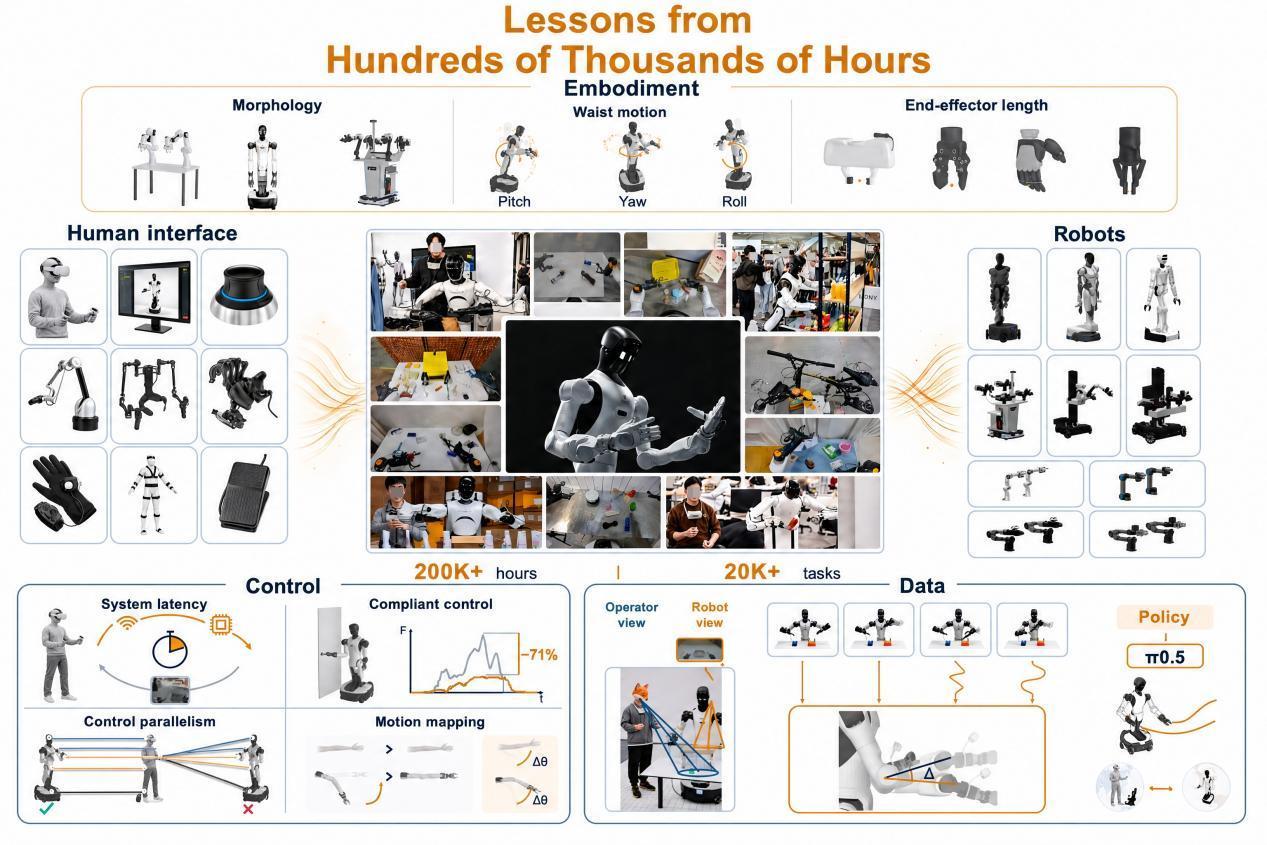
Earlier work examined the data itself. “Hidden Variables Behind Real-Robot Data Quality: Lessons from Hundreds of Thousands of Hours” traces data quality upstream to the collection system. Combining 200,000+ hours of data, 20,000+ task records, a structural analysis of 25 dual-arm robots, teleoperation experiments, and post-training tests on real robots, it analyzes a dozen or so factors across embodiment, control, and data recording.
Three kinds of “successful” data that can mislead a model
Incomplete observation. When a block sat outside the robot’s initial view and the operator chose an arm by eye, the robot’s recording held no basis for the choice. Models trained on that data picked the correct arm about 50% of the time, no better than a coin flip. When the operator shared the robot’s view and searched first, accuracy rose to 100%. A good demonstration records not only what the robot did, but why.
Misaligned calibration. Data from different calibration batches often remained usable when the training set kept a portion consistent with the deployed robot. But when the deployed robot itself carried a zero-offset error, all 30 real-robot trials failed. The model cannot know its learned mapping no longer holds; it simply executes the wrong action with confidence.
Detours that stick. Trained on data with deliberately inserted pauses and detours, models kept about 90% of the extra path. As detour data rose from 0 to 80%, task time grew from 25.3 s to 32.6 s, about 29% longer. A workaround made to offset a system limitation is recorded as “success,” so the model treats it as part of the task.
Where the problems come from: the system, not the operator
Embodiment. “Reachable” is not the same as “capable.” Across 25 mainstream dual-arm robots, looking only at positional reach overstated real task coverage. A gripper 10 cm longer added about 39.4% more reachable positions but pushed joints closer to their limits, while waist motion enlarged the effective workspace by 3.4 to 5.5 times.
Teleoperation Control. When one controller must switch constantly between arms, waist, base, and head, operators act in sequence and pause often. Moving to parallel control cut task time by 43% to 53%. Compliant control lowered peak contact force by 71.3% in door opening and 69.1% in whiteboard wiping. Latency hides in plain sight: a filter that computes in under 1 ms can still add over 200 ms of phase lag, prompting overshoot and correction. Those corrections enter the training set as positive examples.
What makes data effective
For a robotics company, the lasting asset is a loop: gain experience in real scenarios, train on it, and return to validate. Whether a piece of post-training data is effective comes down to three questions. Do the observations cover the basis for the decision? Does the state-to-action mapping still hold on the deployed robot? Is the path in the data a requirement of the task, or a by-product of a system limitation? The answers are written in before the data ever reaches the training pipeline.
Two companion studies
Ego-CEVR (arXiv:2610.37509) learns from inexpensive first-person human video by letting video teach task context and robot actions teach local execution. It reaches 98.1% average success on LIBERO and, in real-robot tests, human video improved three tasks by 10 to 20 percentage points.
ReSTEP and REMORA (arXiv 2610.39125) provide an open-source dataset of 3,156 real-robot episodes with frame-level error labels, and a progress estimator that follows drops and recoveries more accurately than the SARM baseline on the tested tasks.