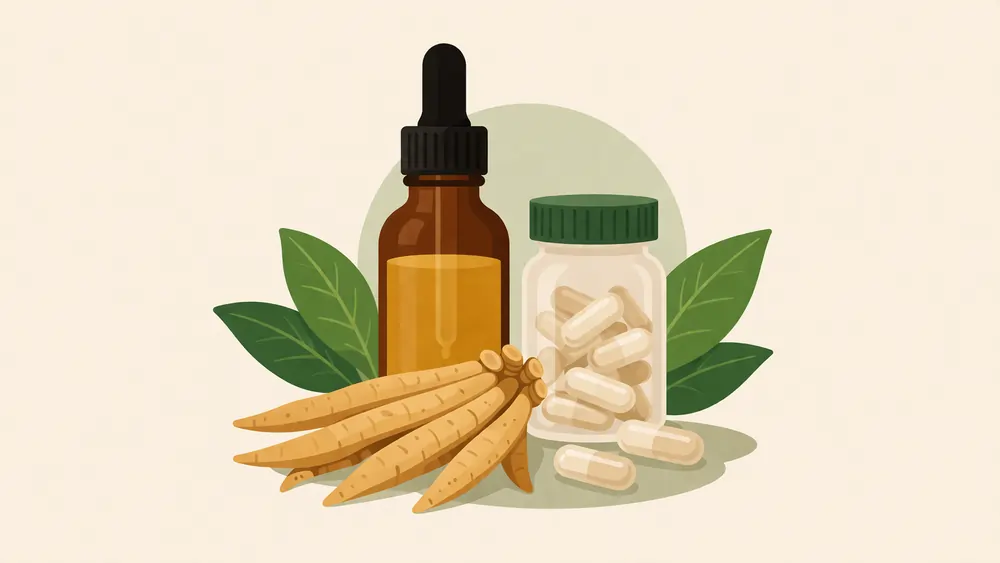
Fingerroot Tincture vs Capsules is not really a question about which format is “better” for everyone. It is a question about fit. Some people want a fast, flexible format they can add to water or take in small measured drops. Others want something simple, portable, and neutral in taste. That is why the real comparison is not tincture versus capsule in the abstract. It is tincture versus capsule inside your actual day, your travel habits, your taste tolerance, and your level of routine consistency.
Fingerroot appears in more than one supplemental form, which means beginners often pause at the same point: should I choose a liquid extract or a capsule? This guide gives a practical answer. It does not promise outcomes. It focuses on format choice, convenience, measuring, storage, daily use, and the small friction points that decide whether a product fits your life or ends up unused in a cabinet.
Quick answer: what is the main difference between fingerroot tincture and capsules?
The main difference is format behavior. A tincture is a liquid extract. A capsule is a pre-measured solid dose. Tinctures usually give you more flexibility in how you take them. Capsules usually give you more convenience, less taste exposure, and cleaner portability.
If you want the shortest possible answer, use this rule:
| Format | Best for | Main tradeoff |
|---|---|---|
| Fingerroot tincture | Flexible routines, adjustable serving use, liquid preference | Taste and measuring effort |
| Fingerroot capsules | Travel, simple daily habits, no-taste preference | Less flexibility in format and serving adjustment |
What is a fingerroot tincture?
A fingerroot tincture is a liquid herbal extract. In practical terms, it is a bottle format that is usually taken in drops, dropperfuls, or another measured liquid serving. The exact extraction method and base can vary by product, so label reading matters.
Why some people prefer tinctures
Tinctures often feel more adaptable. You can add them to a small amount of water. You can keep them in a kitchen routine. You can also integrate them into a morning or evening habit without needing to swallow a pill.
Where tinctures create friction
The friction points are simple and predictable. Taste can be strong. Measuring takes one more step. Bottles are less pocket-friendly than capsules. If your day is rushed, that extra step can become the reason you skip the product.
What are fingerroot capsules?
Fingerroot capsules are a solid, pre-portioned format. Instead of a dropper bottle, you get a set amount per capsule or per serving. This makes the format more familiar to people who already use supplements in capsule form.
Why some people prefer capsules
Capsules remove taste from the decision. They are easy to pack, easy to count, and easy to keep in a simple routine. For many people, that alone is enough to make them the more realistic choice.
Where capsules create friction
Capsules are less flexible. You are working within the serving structure provided by the product. They may also be less appealing to people who dislike swallowing capsules or who prefer liquid formats in general.
Which format is easier for beginners?
For most beginners, capsules are easier. They ask less from the user. You do not have to interpret droppers, dilute anything, or manage a strong flavor. You just follow the serving instructions on the label.
Why capsules win on simplicity
A capsule fits into routines people already know. It works well with breakfast, a supplement organizer, or a travel bag. The process feels standardized and low effort.
Why tinctures still appeal to some beginners
A tincture can still be beginner-friendly if the user strongly prefers liquid products or wants a format that feels more customizable. It is not harder in a technical sense. It just asks for more active participation.
Which format fits a busy daily routine better?
Capsules usually fit a busy routine better. They are faster to take, easier to pack, and less noticeable in public or on the move. If you tend to forget products that require setup, capsules usually have the advantage.
Best fit for workdays and commuting
Capsules are usually the cleaner option for office life, driving days, flights, and routine-heavy schedules. They create less mess and less decision fatigue.
Best fit for home-based routines
Tinctures often fit well at home, especially when you already use a dropper bottle, make tea, or build a small ritual around your daily supplements. In a calm setting, the extra step is less of a problem.
How much does taste matter in this decision?
Taste matters more than people think. It is one of the biggest reasons a supplement format succeeds or fails in real life.
Tincture taste exposure
A tincture puts the flavor question right in front of you. Even when diluted, the taste can still shape the experience. Some people do not mind that at all. Others start with good intentions and quietly stop using the product because the taste never feels easy.
Capsules remove that variable
Capsules are the clear winner for people who want a neutral, low-friction experience. If you already know you dislike strong herbal flavors, capsules are often the smarter choice.
Which format is better for travel?
Capsules are usually better for travel. They are compact, discreet, and easier to manage in a bag, suitcase, or weekly organizer. A bottle can still travel, but it asks for more care.
Why capsules travel better
They are easier to count. They do not require a dropper. They also fit better into short trips, airport routines, and day bags.
When a tincture can still work for travel
A tincture can still work if you prefer liquids and do not mind carrying a bottle carefully. It may fit longer stays better than highly mobile travel days.
How does measuring differ between tinctures and capsules?
Measuring is one of the most practical differences in the whole Fingerroot Tincture vs Capsules decision.
| Category | Tincture | Capsules |
|---|---|---|
| Serving style | Liquid measurement | Pre-portioned units |
| Daily effort | Moderate | Low |
| Flexibility | Higher | Lower |
| Taste exposure | Usually yes | Usually no |
| On-the-go use | Less convenient | More convenient |
Why measurement changes user behavior
A small amount of friction can matter a lot over time. A user may like the idea of a tincture but still use capsules more consistently because the action is faster and more automatic.
Why flexibility still matters
Some users prefer not to feel locked into a fixed capsule experience. They like the sense of control that comes with a liquid format and label-based serving guidance. For them, tinctures feel more responsive to routine changes.
Which format is better if you already take several supplements?
That depends on your current stack. If you already take multiple capsules each day, adding one more capsule may feel easy. If you are trying to reduce pill load, a tincture may feel more comfortable.
Capsules fit supplement stacks well
They line up with pill organizers, breakfast routines, and existing habits. This matters because consistency usually follows familiarity.
Tinctures fit ritual-based routines well
If your routine already includes tea, tonics, or liquid extracts, a fingerroot tincture may feel more natural than another capsule bottle.
What should you check on the label before choosing?
Do not choose by format alone. Read the label. It tells you how usable the product really is.
What to check on a tincture label
- Serving size format
- Ingredients and extract details
- Bottle size
- Storage directions
- How many servings the bottle provides
What to check on a capsule label
- Amount per serving
- Number of capsules per serving
- Capsule count per bottle
- Other ingredients in the capsule
- Serving instructions and storage information
This step matters because two capsule products can behave very differently in practice, and the same is true for tinctures. One bottle may look compact but offer very few servings. One capsule product may require more capsules per serving than you expect.
Checklist: how to choose the better format for your routine
- Choose capsules if you want the simplest daily experience.
- Choose capsules if you dislike strong herbal taste.
- Choose capsules if you travel often or work outside the home.
- Choose tincture if you prefer liquid formats over swallowing capsules.
- Choose tincture if you like a more hands-on routine.
- Check serving size and servings per container before buying.
- Check ingredients, storage, and usage instructions on the label.
- Pick the format you are most likely to use consistently, not the one that only sounds good in theory.
Which format fits different lifestyle scenarios better?
The best answer often comes from the scenario, not the product category.
Best fit for travel-heavy lifestyles
Capsules usually win. They are compact and predictable.
Best fit for minimal-taste routines
Capsules usually win again because they reduce sensory friction.
Best fit for kitchen-based wellness routines
Tinctures often make sense here. They sit naturally next to teas, herbal blends, and other liquid products.
Best fit for people who dislike swallowing pills
Tinctures may be the more comfortable option, even if they require more measuring.
Can you switch from one format to the other later?
Yes. For many people, format choice is not permanent. It can change with season, routine, travel schedule, or taste tolerance.
When people move from tincture to capsules
This often happens when life gets busier, travel increases, or taste becomes a bigger issue than expected.
When people move from capsules to tincture
This often happens when they want a liquid format, want fewer capsules in their day, or prefer a more flexible routine at home.
FAQ about Fingerroot Tincture vs Capsules
Is fingerroot tincture better than capsules?
Not universally. The better format is the one that fits your routine, taste preference, and daily consistency.
Are capsules easier than tinctures?
Usually yes. Capsules are simpler to carry, count, and take quickly.
Do tinctures have a stronger taste?
Usually yes. A tincture exposes you more directly to the herbal flavor.
Which format is better for travel?
Capsules are usually more travel-friendly because they are compact and easy to pack.
Which format is better if I hate swallowing pills?
A tincture may fit better if you prefer liquid formats.
Should I check serving size before buying?
Yes. Serving size and servings per container help you compare real-world usability.
Can I switch formats later?
Yes. Many people change formats when their routine or preferences change.
Glossary
Fingerroot
A rhizome commonly identified as Boesenbergia rotunda, also known in some regions as krachai.
Tincture
A liquid herbal extract taken in measured amounts.
Capsule
A pre-portioned supplement format designed for convenient swallowing.
Serving size
The amount of a product listed for one suggested use on the label.
Servings per container
The total number of suggested servings in a bottle or package.
Extract
A concentrated preparation made from plant material.
Routine fit
How well a product format matches daily habits, preferences, and lifestyle.
Supplement Facts
The label panel that lists serving information and dietary ingredients for a supplement product.
Conclusion
Fingerroot tincture and capsules can both make sense, but they solve different routine problems. Choose the format you will actually use with the least friction, because consistency usually starts with convenience, not theory.
Sources
Accepted botanical identity and naming reference for fingerroot, Plants of the World Online — powo.science.kew.org
Produce and ingredient overview noting fingerroot forms such as fresh, dried, powdered, and extract, Specialty Produce — specialtyproduce.com/produce/Fingerroot_Ginger_11704.php
Consumer background on botanical dietary supplements and common product forms, NIH Office of Dietary Supplements — ods.od.nih.gov/factsheets/BotanicalBackground-Consumer
FDA overview of dietary supplement labeling requirements, including serving size and ingredient disclosure, U.S. Food and Drug Administration — fda.gov/food/information-consumers-using-dietary-supplements/questions-and-answers-dietary-supplements
FDA guidance on dietary supplement good manufacturing practices and product quality controls, U.S. Food and Drug Administration — fda.gov/food/dietary-supplements-guidance-documents-regulatory-information/backgrounder-final-rule-current-good-manufacturing-practices-cgmps-dietary-supplements