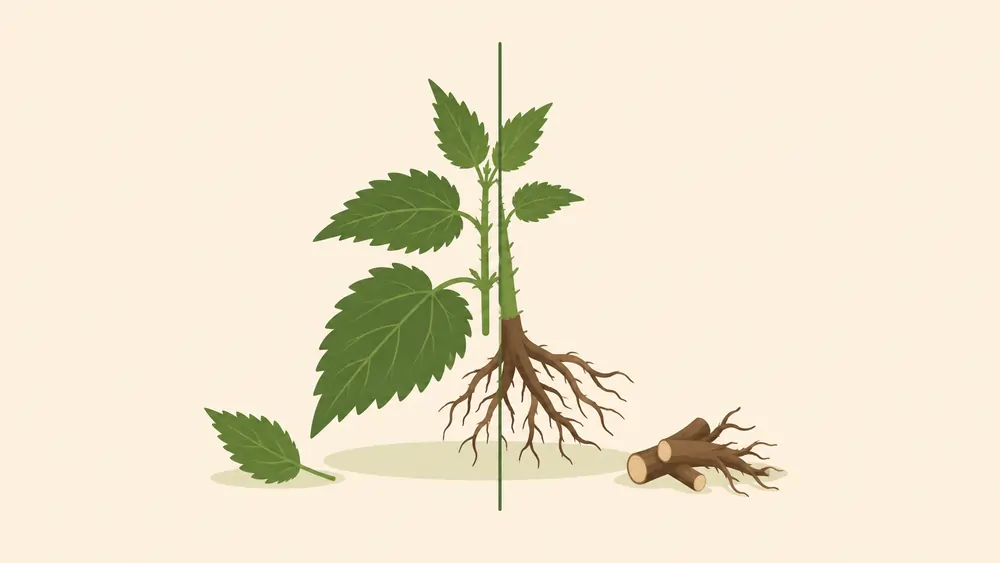
Nettle leaf vs nettle root is not a small label detail. These are different parts of the same plant category, and they are commonly used in different product formats. Nettle leaf often appears in tinctures, capsules, teas and daily herbal wellness products. Nettle root often appears in capsules, extracts, and tinctures with a different traditional positioning. If a label only says “nettle,” you may not know what you are actually buying.
Stinging nettle is commonly listed as Urtica dioica, but the botanical name alone does not tell you the plant part. HerbEra treats this as a label-reading issue first: a careful buyer should check species, plant part, format, serving size, and warnings before choosing a nettle product.
This article does not provide medical advice. Nettle supplements are not intended to diagnose, treat, cure, or prevent any disease. If you take medication, are pregnant or breastfeeding, have kidney concerns, allergies, or a diagnosed health condition, speak with a qualified healthcare professional before using nettle leaf, nettle root, or any nettle supplement.
Nettle Leaf vs Nettle Root: What Is the Difference?
The difference is the plant part. Nettle leaf comes from the above-ground leaf material. Nettle root comes from the underground root. They may come from the same general plant species, but they are not the same ingredient in a supplement routine.
Nettle leaf is commonly used in dried tea, loose leaf blends, capsules, tinctures, and whole-herb style products. Nettle root is more common in root extracts, capsules, tinctures, and formulas that specify root on the label.
This matters because plant parts can have different traditional uses, different preparation styles, different label directions, and different buyer expectations. A tea made from nettle leaf is not the same product as a capsule made from nettle root extract.
Quick Label Guide: What the Terms Usually Mean
| Label Term | Usually Means | Common Format | Buyer Note |
|---|---|---|---|
| Nettle leaf | Above-ground leaf | Tea, capsules, tincture | Often used for daily herbal wellness routines |
| Nettle root | Root part | Capsules, extracts, tincture | Different traditional positioning from leaf |
| Whole herb | Mixed aerial parts | Tea, powder, extract | Check whether it includes leaf, stem, or flowering parts |
| Aerial parts | Above-ground plant material | Tea, tincture, capsules | Not the same as root |
| Urtica dioica | Botanical name | Many formats | Confirms species, not plant part |
Why the Plant Part Matters
The plant part matters because leaves, roots, seeds, stems, and flowers are not interchangeable. They can differ in texture, preparation, traditional context, and the compounds emphasized by manufacturers.
For nettle, leaf and root are the two plant parts buyers most often confuse. A shopper may search for “nettle tea” and expect leaf, but then find capsules labeled nettle root. Another shopper may search for “nettle supplement” and not realize the product uses leaf, root, or aerial parts.
The label should tell you the plant part. In dietary supplement labeling, botanical dietary ingredients should identify the part of the plant from which the ingredient is derived. This is why a careful buyer should read the Supplement Facts panel, not only the front of the bottle.
What Is Nettle Leaf Usually Used For in Products?
Nettle leaf is the plant part most people associate with nettle tea. It can appear as loose dried leaf, tea bags, powder, capsules, or tincture. It may also be listed as nettle herb or aerial parts if the product includes above-ground material beyond only the leaf.
Nettle leaf tea usually has a green, earthy, grassy, and vegetable-like taste. It is more like a leafy herbal infusion than a sweet tea. Many beginners encounter nettle through dried leaf tea before trying capsules or tinctures.
From a buying standpoint, nettle leaf is often the better match when the user wants a simple herbal tea routine. Still, the label should confirm the plant part and suggested use.
What Is Nettle Root Usually Used For in Products?
Nettle root is the underground part of the plant. It is more likely to appear in capsules, extracts, and tinctures than in basic tea bags. It has a different traditional positioning from nettle leaf, so buyers should not assume it serves the same product role.
Root products may be standardized extracts or concentrated preparations. They may also have different serving sizes from leaf products. This makes label reading especially important.
If you want nettle leaf tea, do not buy nettle root capsules by accident. If you want a product specifically labeled as root, confirm that the label says root, not leaf, herb, or aerial parts.
Is “Whole Herb” the Same as Nettle Leaf?
Not always. “Whole herb” often refers to above-ground plant material, but the term can be vague for buyers. It may include leaf, stem, flowering tops, or other aerial parts depending on the product and manufacturer.
Whole herb is not the same as root unless the label clearly says root is included. It is also not automatically the same as pure leaf.
When you see “whole herb,” check the Supplement Facts panel and the ingredient list. The label should clarify the plant part. If it does not, the product may not be clear enough for a beginner who needs a specific nettle form.
Does Urtica dioica Tell You Leaf or Root?
No. Urtica dioica tells you the botanical species, not the plant part. A label can say Urtica dioica leaf, Urtica dioica root, Urtica dioica aerial parts, or Urtica dioica extract.
This is one of the most common buyer mistakes. People see the Latin name and assume the product is correct. But species and plant part answer two different questions.
Use this simple rule: the botanical name tells you “which plant,” while the plant part tells you “which part of the plant.” You need both details to understand the product.
Nettle Tea: Why It Usually Means Leaf
Nettle tea usually means dried nettle leaf or above-ground nettle herb. Leaf material is easier to infuse and is commonly sold in tea bags or loose leaf products.
Nettle root is less common as a casual tea ingredient. Root material may require different preparation and is more often sold as capsules, extracts, or tinctures.
If a tea label only says “nettle,” read the ingredient panel. It should specify nettle leaf, nettle herb, or another plant part. Do not assume every nettle tea uses the same material.
Capsules and Tinctures: Why Confusion Happens
Capsules and tinctures can use either leaf or root. This is where buyers get confused. The same product format does not tell you the plant part.
A nettle capsule may contain nettle leaf powder, nettle root extract, or a blend. A nettle tincture may use leaf, root, aerial parts, or another preparation. The bottle shape does not answer the question.
HerbEra takes a practical editorial stance here: when the format looks similar, the label becomes the decision-maker. Do not buy a nettle capsule or tincture until the plant part is clear.
How to Read a Nettle Supplement Label
| Label Area | What to Look For | Why It Matters |
|---|---|---|
| Front label | Leaf, root, herb, or extract wording | Gives the first clue, but may be incomplete |
| Supplement Facts | Plant part and serving size | Shows what you take per serving |
| Ingredient list | Other ingredients, capsule material, alcohol base | Helps check suitability and preferences |
| Botanical name | Urtica dioica or another listed species | Confirms plant identity, not plant part by itself |
| Suggested use | How the product says to take it | Leaf tea, root extract, and tincture may differ |
| Warnings | Medication, pregnancy, breastfeeding, and condition cautions | Helps avoid unsafe self-directed use |
Buying Mistake: Choosing “Nettle” Without the Plant Part
The biggest mistake is buying a product because it says “nettle” without checking whether it is leaf or root. This is especially common on marketplaces where product titles are short and images are hard to read.
If you want tea, choose a product that clearly says nettle leaf or dried nettle leaf. If you want root, choose a product that clearly says nettle root. If you want a tincture, confirm whether it uses leaf, root, or aerial parts.
Do not rely only on search results. Search engines may show leaf and root products together. The label must make the final decision.
Safety Notes Before Using Nettle Leaf or Root
Nettle leaf and nettle root may not be suitable for everyone. People who take medication should ask a qualified healthcare professional before using nettle products, especially if the medication relates to blood pressure, blood sugar, blood thinning, fluid balance, or kidney function.
Pregnant and breastfeeding people should also ask before using nettle products. Safety considerations can vary by product type, plant part, serving size, and personal situation.
Fresh nettle plants can sting and irritate the skin. Dried or prepared products are different from fresh plant handling, but label directions and warnings still matter.
What Nettle Leaf and Root Should Not Be Used For
Nettle leaf and nettle root should not be used as substitutes for medical care. Do not use nettle products to self-manage diagnosed conditions or symptoms that are severe, unusual, persistent, or worsening.
Avoid product descriptions that make strong disease-related promises. Safe supplement education can explain plant parts, formats, labels, and routines without making medical claims.
If you are choosing between leaf and root for a specific health concern, that is a professional guidance question, not a casual label-reading decision.
Nettle Leaf vs Nettle Root Buyer Checklist
Use this checklist before buying nettle tea, capsules, tincture, powder, or extract. The goal is to avoid plant-part confusion and choose the product that actually matches your intended routine. A clear label saves time and prevents wrong-format purchases.
Find the Plant Part
Look for leaf, root, aerial parts, herb, or whole herb. Do not stop at the word “nettle.”
Check the Botanical Name
Look for Urtica dioica or another clearly listed species. Remember that the botanical name confirms the plant, not the plant part.
Match the Format to Your Goal
Choose dried leaf for a basic tea routine. Choose root only if the label clearly matches the product type you intended to buy.
Read the Supplement Facts Panel
Check serving size, plant part, extract details, and amount per serving. Front-label wording may not be enough.
Review Other Ingredients
Look for capsule material, alcohol base, glycerin, fillers, flavors, or allergens. These details affect suitability.
Check Warnings Before Use
Review cautions for pregnancy, breastfeeding, medication use, kidney concerns, allergies, and health conditions.
Avoid Vague Product Listings
If the product does not clearly identify the plant part, choose a clearer label. Ambiguity is not beginner-friendly.
Common Mistakes to Avoid
Thinking All Nettle Products Are the Same
Nettle leaf, root, seed, and aerial parts are not identical. The plant part changes the product category.
Assuming Nettle Tea Means Root
Nettle tea usually means leaf or aerial parts. Root is more often found in capsules, extracts, and tinctures.
Reading Only the Front Label
The front label can be vague. Always check the Supplement Facts panel and ingredient list.
Confusing Species With Plant Part
Urtica dioica identifies the plant species. It does not tell you whether the product uses leaf or root.
Ignoring Medication and Health Cautions
Nettle products may not fit every person. Ask a qualified professional when medication, pregnancy, breastfeeding, kidney concerns, or health conditions apply.
FAQ about Nettle Leaf vs Nettle Root
Is nettle leaf the same as nettle root?
No. Nettle leaf comes from the above-ground leaf material, while nettle root comes from the underground root.
Which is used for nettle tea?
Nettle tea usually uses dried nettle leaf or aerial parts. Always check the label to confirm the plant part.
Is nettle root used in tea?
Nettle root is less common as a basic tea ingredient and more common in capsules, extracts, and tinctures.
Does Urtica dioica mean leaf or root?
No. Urtica dioica is the botanical name. The label must still specify leaf, root, aerial parts, or another plant part.
What does “whole herb” mean on a nettle label?
Whole herb usually means above-ground plant material, but it can be vague. Check the Supplement Facts panel for plant-part details.
Can a nettle tincture use leaf or root?
Yes. A tincture can use leaf, root, aerial parts, or another preparation. The label should specify the plant part.
Can a nettle capsule use leaf or root?
Yes. Nettle capsules may contain leaf powder, root extract, or another nettle preparation. Read the label before buying.
What should I check before buying nettle supplements?
Check the plant part, botanical name, serving size, extract details, other ingredients, suggested use, and warnings.
Who should ask before using nettle products?
People taking medication, pregnant or breastfeeding people, and those with kidney concerns, allergies, or health conditions should ask a qualified professional first.
Glossary
Nettle Leaf
The leaf part of the nettle plant, commonly used in dried tea, capsules, tinctures, and herbal blends.
Nettle Root
The underground root part of the nettle plant, commonly used in capsules, extracts, and tinctures.
Urtica dioica
The botanical name commonly associated with stinging nettle.
Aerial Parts
The above-ground parts of a plant, such as leaves, stems, and flowering tops.
Whole Herb
A term often used for above-ground plant material, though the exact meaning should be confirmed on the label.
Supplement Facts
The label panel that lists serving size, dietary ingredients, and required supplement information.
Tincture
A liquid extract usually taken directly or diluted in water.
Extract
A concentrated preparation made from plant material using a solvent or extraction process.
Plant Part
The specific part of the plant used in a product, such as leaf, root, seed, stem, or flower.
Conclusion
Nettle leaf vs nettle root matters because the word “nettle” alone is not enough. Check the plant part, botanical name, format, serving size, and warnings before buying tea, capsules, tincture, or extract.
Sources
FDA dietary supplement labeling rule requiring the plant part for botanical dietary ingredients, U.S. Food and Drug Administration — fda.gov/food/dietary-supplements-guidance-documents-regulatory-information/dietary-supplement-labeling-guide-chapter-iv-nutrition-labeling
Stinging nettle overview describing leaf, flowering parts, and root extracts, LiverTox / NCBI Bookshelf — ncbi.nlm.nih.gov/books/NBK589898
Stinging nettle safety, allergy, pregnancy, and breastfeeding cautions, WebMD — webmd.com/vitamins-and-supplements/stinging-nettle-uses-and-risks
Federal dietary supplement nutrition labeling requirements, Electronic Code of Federal Regulations — ecfr.gov/current/title-21/chapter-I/subchapter-B/part-101/subpart-C/section-101.36
Stinging nettle ingredient overview with root and above-ground part distinction, WebMD — webmd.com/vitamins/ai/ingredientmono-664/stinging-nettle